- Made to Exterminate: (647)-956-5868
- info@pesterminate.ca


How Much Does Rodent Control and Exclusion Cost in Toronto?
Have Any Question?
Contact us, our service man will give you support ASAP to move your live without pest problem.
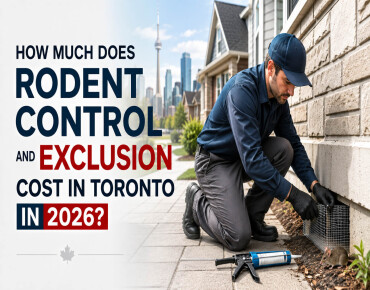
How Much Does Rodent Control and Exclusion Cost in Toronto?
Learn how much rodent control and exclusion costs in Toronto in 2026, including typical prices for mice, rats, extermination, proofing, and entry point sealing. Compare cost factors and know what to expect before hiring a professional pest control company.
Finding mouse droppings under the sink, hearing scratching behind a basement wall, or spotting a rat near your property raises two immediate questions: how serious is the problem, and how much will it cost to fix? The rodent control cost Toronto homeowners and property managers pay in 2026 depends largely on whether they need basic trapping or baiting, a more involved treatment program, or full rodent exclusion that closes the openings allowing mice or rats inside. This guide explains realistic Toronto pricing, what affects your quote, the difference between extermination and exclusion, and how to compare pest control proposals without paying for work you do not need. In Toronto, basic professional mouse or rat control commonly falls around CAD $150–$500, while rodent control combined with substantial exclusion or steel sealing can cost roughly $400–$800 or more. Complex infestations, extensive proofing, repeated visits, difficult access, cleanup, or structural repairs can push the total above $1,000. These figures are useful planning ranges, not fixed rates. Published Toronto service prices vary by company, property size, infestation severity, treatment method, number of visits, and the amount of exclusion work required. Current advertised Toronto and GTA pricing suggests that straightforward rodent treatment remains relatively affordable compared with extensive proofing work. One Toronto provider lists mice at approximately CAD $195–$475 and rats at $295–$495. Another 2026 GTA pricing guide lists mice or rat trapping at $200–$350 and mouse treatment with steel exclusion at $400–$800+. A separate Toronto provider gives approximately $150–$350 for one-time mouse treatment and up to $1,000 for more involved cases. Bottom line: a few hundred dollars may address a straightforward infestation, but a lasting solution can cost more if mice or rats are entering through multiple structural openings. These ranges reflect publicly advertised service information available in 2026. They should be used for budgeting and comparison rather than as guaranteed prices. Before publishing or relying on a specific amount, verify the company's current pricing, what taxes are included, how many visits are covered, and whether exclusion materials or repairs cost extra. Rodent control deals with the mice or rats currently active on the property. Rodent exclusion addresses how they are getting inside and helps prevent new rodents from replacing them. That distinction explains why two Toronto homeowners with similar mouse problems can receive very different quotes. Health Canada advises that poisoned bait should not be the only rodent-control method. Rodent-proofing and sanitation are also necessary parts of satisfactory mouse and rat control. For a homeowner comparing rodent exclusion Toronto services, that is an important point: removing the current population and preventing re-entry are related but different jobs. A reasonable budget for basic professional mouse treatment is approximately $150–$475, based on current published Toronto pricing. The mouse exterminator cost Toronto residents receive may be toward the lower end when: The mice control cost Toronto homeowners face usually rises when mice have spread between several floors, are nesting in inaccessible voids, or continue entering through multiple exterior gaps. Exclusion is more labour- and material-intensive than simply placing traps. A 2026 GTA pricing guide lists mice treatment with steel exclusion or sealing at approximately $400–$800+. The actual mouse proofing cost Toronto property owners pay can be higher where technicians need to work around complicated rooflines, masonry gaps, garages, additions, decks, utility penetrations or numerous openings. Basic professional rat treatment commonly falls in roughly the $200–$500 range, although difficult infestations can cost considerably more. Toronto pricing references include approximately $295–$495 for rat services and $200–$350 for rodent trapping. The rat exterminator cost Toronto property owners receive may increase if the problem involves: The City of Toronto identifies sightings, droppings, burrows, gnaw marks, tracks and established travel pathways as common signs of rodent activity. It also advises property owners to remove food and shelter sources and seal cracks and openings. There is no reliable flat rate for every property because exclusion is essentially a building-envelope problem. A technician may find one obvious opening around a utility pipe or dozens of vulnerable locations around a detached property's foundation, soffits, vents and additions. A single repair costs less than systematically proofing an entire exterior. Ground-level gaps are generally easier to access than openings around rooflines, upper-storey vents or confined spaces. Professional exclusion may require metal mesh, flashing, cement or other durable materials rather than temporary filler. Public Health Agency of Canada guidance recommends blocking rodent openings using materials such as wire screening, steel wool, metal flashing or cement. A detached Toronto house generally provides more exterior perimeter to inspect than a small condo unit. Older brick homes, additions, attached garages, utility penetrations and shared-wall properties may also present more complicated access routes. More rodents can mean more devices, more monitoring and additional visits before the job is considered controlled. Rotten wood, damaged vents, major masonry problems or other construction deficiencies may require a contractor rather than or in addition to a pest technician. Quick summary: exclusion pricing is driven less by the number of mice you see and more by the number, location and complexity of the openings that need to be corrected. A low advertised price does not necessarily represent the final rodent removal cost Toronto homeowners will pay. Before hiring a company, ask for the scope in writing. A useful quote should clarify: Rodent exclusion is usually worth considering when the infestation is caused by identifiable structural entry points or has returned after previous treatment. Control alone can reduce an active population, but it does not automatically stop another mouse or rat from entering through the same opening. Health Canada specifically recommends combining rodent control with proofing and good sanitation rather than relying only on poison. Exclusion may be less extensive when the rodent entered through a temporary condition for example, an exterior door repeatedly left open and a full building inspection finds no significant structural access points. The best approach is therefore not "buy the most exclusion possible." It is to identify the actual access routes and repair the vulnerabilities that matter. A well-designed rodent program typically follows this sequence: The technician looks for droppings, gnaw marks, nesting material, rub marks, burrows and other signs of activity. Mouse and rat behaviour differs, so identifying the pest helps determine trap placement, monitoring and exclusion priorities. Appropriate trapping, baiting or other approved control methods are selected for the property. Garbage, pet food, fallen fruit, clutter and other attractants can make control more difficult. Toronto specifically advises property owners to secure waste, eliminate food sources and remove clutter that provides shelter. Openings around the foundation, walls, doors, vents and utilities are repaired using appropriate rodent-resistant materials. The technician checks whether activity has stopped and whether additional access points or treatment areas need attention. These examples are budgeting scenarios, not quotes. A resident finds droppings under the kitchen sink and hears occasional movement behind a cabinet. If the issue is limited to the unit and only basic treatment is necessary, a reasonable planning budget might be approximately $150–$350. If mice are entering through common building infrastructure, however, treating one unit may not solve the building-wide source. A homeowner has mouse activity in the basement and kitchen, and an inspection identifies several exterior gaps. Treatment plus substantial steel exclusion could fall around $400–$800+, depending on the amount of sealing required. A property manager sees outdoor burrows, garbage-area activity and evidence near the basement. The initial treatment may fall within several hundred dollars, but repeated service, exclusion, sanitation corrections or structural work can take a complex case toward or beyond $1,000. Published Toronto pricing for specialized rodent treatment can reach this level. Toronto rental properties are required to be maintained free of pest infestations and conditions that encourage them. Toronto's property standards information states that properties must be kept free of rodents and other pests. For rental units, the City advises tenants to contact the landlord or property manager first and make the extermination request in writing. If the issue is not addressed within a reasonable period, tenants may contact 311. For landlords and property managers, early action is often the more practical approach. A mouse problem affecting one unit can become more difficult to resolve if rodents are travelling through shared walls, utility chases or common areas. Responsibilities can depend on the property and circumstances, so legal questions should be checked against current City of Toronto requirements and Ontario tenancy rules. A $200 treatment and a $600 treatment may not be comparable if the second includes multiple visits and exterior exclusion. Reducing rodents without correcting access can leave the property vulnerable to reinfestation. Health Canada recommends proofing and sanitation as part of rodent management. Exclusion should be coordinated with active control and monitoring. Otherwise, rodents already inside may remain trapped within the structure or simply use another opening. Open garbage, food waste, clutter and shelter around the building can continue supporting rat activity. The City of Toronto specifically recommends controlling these conditions. A long warranty is useful only if you know what is covered. Ask whether new openings, structural deterioration or activity originating from neighbouring properties are excluded. Do not casually vacuum or sweep dry rodent droppings. Canadian public-health guidance warns that this can release contaminated particles into the air. Current guidance recommends wetting and disinfecting contaminated material and using appropriate protective equipment. Basic mouse treatment in Toronto commonly costs about $150–$475. Current published Toronto prices vary within that range depending on the provider and service scope. Exclusion can raise the total considerably because sealing exterior openings requires additional labour and materials. A full quote should distinguish treatment from proofing rather than combining everything under one unexplained price. A straightforward rat-control service may cost approximately $200–$500 in Toronto. More complicated infestations can cost more when they involve several burrows, repeat visits, exterior bait stations, inaccessible areas or structural exclusion. One Toronto provider lists rat service at roughly $295–$495, while another 2026 guide lists general rodent trapping around $200–$350. Rodent exclusion commonly starts in the several-hundred-dollar range and can exceed $800 when extensive proofing is required. One 2026 GTA guide places mouse treatment with steel exclusion around $400–$800+. Larger properties with many gaps, difficult roofline access or significant structural repairs may require a custom quote. Exclusion usually provides better long-term protection when rodents are entering through structural openings. Extermination or trapping addresses the current population, while exclusion reduces the opportunity for new rodents to enter. Health Canada recommends combining control with rodent-proofing and sanitation instead of relying on poisoned bait as the only measure. There is no universal number of visits. A limited mouse problem may need fewer follow-ups than an established rat infestation or multi-unit property. Ask whether monitoring and return visits are included in the original price, how long the service period lasts, and what conditions must be met before the company considers the infestation controlled. Small, isolated problems may sometimes be managed with traps, sanitation and careful rodent-proofing, but persistent activity deserves professional assessment. If using pesticides, follow the label exactly and use products approved for the intended application. Health Canada also advises that bait should not be the only strategy and provides specific safety guidance for rodent cleanup. Property size, infestation severity, difficult access, number of entry points, follow-up visits and exclusion work are major cost drivers. Published Toronto providers similarly identify property size, severity and treatment method as factors affecting pricing. A quote becomes substantially more expensive when pest treatment turns into extensive building-envelope repair. Landlords and property managers should address pest problems affecting rental-property standards, although the circumstances of individual cases can differ. The City of Toronto advises tenants to report the problem to their landlord or property manager in writing first and permits a 311 service request when the issue is not addressed within a reasonable time. For most properties, the key to understanding rodent control cost in Toronto is separating three expenses: controlling the rodents already present, finding how they entered, and repairing the openings that could allow the problem to return. Basic mouse or rat treatment may cost a few hundred dollars. Treatment combined with meaningful exclusion commonly moves into the $400–$800+ range, while severe infestations, difficult access, substantial proofing, contamination cleanup or structural repairs can take the total above $1,000. Instead of automatically choosing the lowest price, compare the inspection, number of visits, exclusion scope, materials, warranty and follow-up service included in each quote. The best value is a plan that addresses both the active infestation and the conditions allowing rodents to enter.
Direct Answer
Rodent Control Cost Toronto: What Should You Budget in 2026?
Service Typical 2026 Planning Range What May Be Included Rodent inspection $0–$150 Inspection, activity assessment, entry-point review Basic mouse control $150–$475 Traps, bait stations, monitoring, limited treatment Basic rat control $200–$500 Trapping/baiting, monitoring, treatment plan Mouse control with exclusion $400–$800+ Treatment plus steel mesh or other entry-point sealing Complex or severe rodent treatment $350–$1,000+ Additional traps, visits, monitoring or specialized treatment Extensive whole-property proofing Custom quote Multiple exterior repairs, vents, roofline, foundation and utility gaps Important pricing note
What Is the Difference Between Rodent Control and Rodent Exclusion?
Rodent control may include:
Rodent exclusion may include:
How Much Does Mouse Control Cost in Toronto?
When does mouse proofing increase the price?
How Much Does Rat Control Cost in Toronto?
What Determines Rodent Exclusion Cost in Toronto?
1. Number of entry points
2. Location of the openings
3. Materials required
4. Property size and construction
5. Severity of the infestation
6. Repairs beyond pest control
What Should a Rodent Control Quote Include?
Is Rodent Exclusion Worth Paying For?
What Does Professional Rodent Control and Exclusion Usually Involve?
Step 1: Inspect the property
Step 2: Identify the rodent and activity areas
Step 3: Reduce the active infestation
Step 4: Correct food and shelter conditions
Step 5: Seal entry points
Step 6: Monitor and follow up
Practical Rodent Control Cost Examples
Example 1: Light mouse activity in a condo
Example 2: Mice in a detached Toronto house
Example 3: Established rat activity around a rental property
Are Toronto Landlords Responsible for Rodent Problems?
Common Mistakes That Can Increase Rodent Control Costs
Choosing a quote based only on price
Paying for bait without addressing entry points
Sealing random holes without an overall control plan
Ignoring outdoor conditions
Comparing warranties without reading the conditions
Cleaning dry droppings with a vacuum
Expert Tips for Getting Better Value From Rodent Control
Frequently Asked Questions
How much does a mouse exterminator cost in Toronto?
How much does a rat exterminator cost in Toronto?
How much does rodent exclusion cost in Toronto?
Is rodent exclusion better than extermination alone?
How many visits does professional rodent control require?
Can I handle a mouse problem myself?
What makes rodent control more expensive?
Who pays for rodent control in a Toronto rental?
Conclusion